
article · Published 27 July 2026 · By Pride Legal Thailand
Thailand’s Marriage Equality Act, one year on. The legal change, the tourism economy, the wedding industry, human rights and the region.
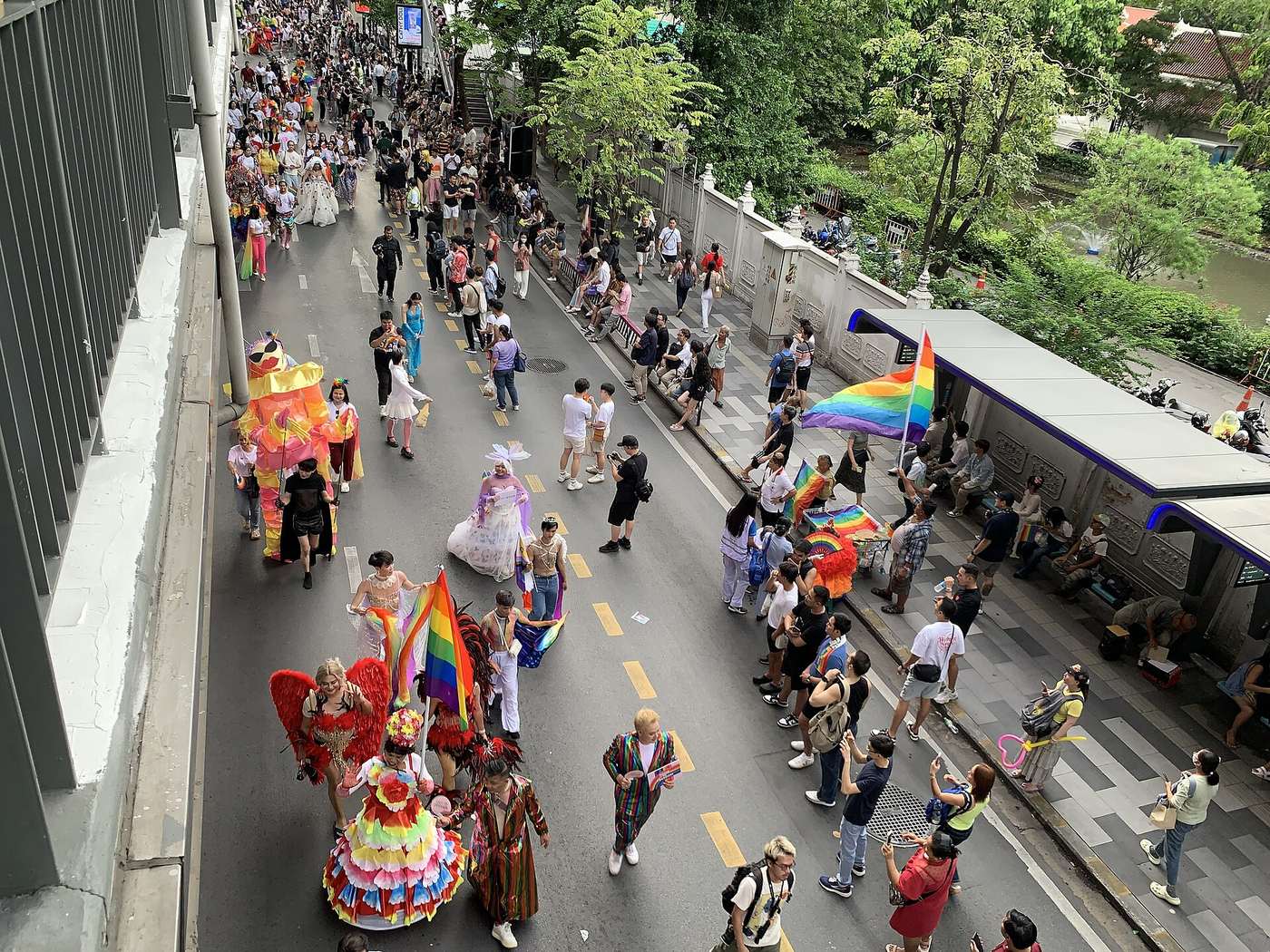
Photo: Bangkok Pride 2024 (01-06-2024) - img 62, by Chainwit., CC BY 4.0, Wikimedia Commons
Thailand’s Marriage Equality Act came into force on 23 January 2025, and its effects have run far beyond the couples who registered in its first year. The law made Thailand the first country in Southeast Asia, and the third in Asia after Taiwan and Nepal, where two people of any gender can marry. Such change has implications in several directions at once.
For a couple reading from abroad, the practical consequence is that same-sex marriage in Thailand is open to two foreigners with no connection to the country. This article looks at what else the law changed.
The Act amended the marriage provisions of the Civil and Commercial Code so that marriage is a contract between two persons rather than between a man and a woman. The amendment carried the whole body of marriage law with it. Married couples of any gender now hold the same legal position as any other married couple, including in inheritance, in marital property and in adoption. The change applies to foreigners as well as Thais, which is the detail with the largest international consequence, because a couple with no connection to Thailand can marry here.
The clearest numbers so far come from a study commissioned by Agoda, which projected that marriage equality would bring Thailand around four million additional international visitors each year and nearly two billion United States dollars in added tourism revenue within two years of enactment. The same study projected around one hundred fifty thousand additional full-time jobs across tourism and the wider economy, lifting gross domestic product by roughly a third of a percentage point. Projections are not results, and the study’s numbers are the industry’s expectation rather than a measured outcome. What is already measurable is the direction. The Tourism Authority of Thailand now promotes the country as a destination for LGBTQ travelers.
A country where foreign couples can legally marry and friendly toward them competes in a market that barely existed in Asia before 2025. Destination weddings were already a Thai industry. Legal destination marriages are a new layer on top of it, because the couple leaves not only with photographs but with a certificate that recognizing countries accept. Hotels, planners, photographers and law firms are building services around that difference, and the couples arriving are not only from Asia. Couples come from countries where marriage is impossible at home, and from countries where it is possible but where Thailand is simply the place they want to stand when it happens.
The United Nations in Thailand marked the law’s first anniversary as a landmark for equality in the region, and the law’s symbolic weight inside Thailand has been as large as its legal weight. Visibility changed. Couples marry in district offices in ordinary hours on ordinary days, and the state records it without comment. The law also sharpened the remaining gaps. Thailand does not yet have a legal gender recognition law, so transgender people marry under the gender recorded at birth, and questions around surrogacy and family formation remain only partly answered. Advocates inside Thailand describe the Act as a floor rather than a ceiling.
Thailand’s neighbours watched the law pass, and the region’s activists now argue with a nearby example rather than a distant one. Taiwan, Nepal and Thailand form an Asian precedent line, and discussion of recognition or partnership laws continues in several countries in the region. No neighbour has followed yet, and predicting law is guesswork. What can be said is that Thailand converted a human rights argument into a working system that its neighbours can inspect, and into an economy they can measure.
For a foreign couple, the implications above reduce to one practical fact. Thailand is the place in Asia where a same-sex marriage is legal, established, and supported by a working infrastructure of embassies, translators, legalization and district offices. Pride Legal Thailand was created to become the platform for the LGBTQ community around the world looking to get married in Thailand, plannable from abroad and completable in a single trip.
Pride Legal Thailand arranges the registration of marriages in Thailand for two people of any gender and any nationality. The fee is ฿49,000 (~1,480 USD) for both partners, fixed, with VAT and government fees included; registration outside the Bangkok region costs ฿10,000 (~300 USD) more.
The service page on marriage registration in Thailand for foreign couples lists the documents, the fee stages and the days required. The steps in order: how two foreigners can get married in Thailand.
General information, not legal advice for a specific case. A couple's exact path depends on their countries and documents. Ask ELSA or write to help@pridelegal.co.th.
article · 31 July 2026
Bangkok’s pink economy after marriage equality. The reported numbers, the WorldPride 2030 bid, and what it means for a couple marrying in Thailand.
article · 24 July 2026
Bangkok, Phuket, Chiang Mai, Pattaya and Hua Hin compared for LGBTQ travelers and couples, for a holiday, a wedding trip, or both.
 ELSA
ELSA